


A Budding Flower...in Space!
A Budding Flower...in Space!

Dear Planetarium and Space Club Member,
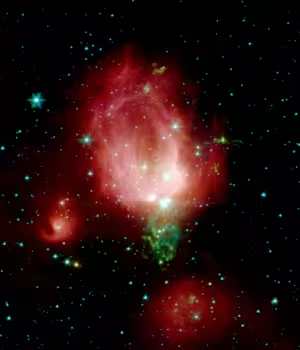
The Flower Bud Nebula is an active star-forming region about 3300 light-years away. Here’s a false-color picture of it, taken in 2004 in infrared light with NASA’s retired Spitzer Space Telescope.
The James Webb Space Telescope is NASA’s current premier infrared observatory; it has a much bigger mirror than Spitzer had, and much better instruments and detectors. Look at Webb’s false-color picture of the same nebula, released just this past week.
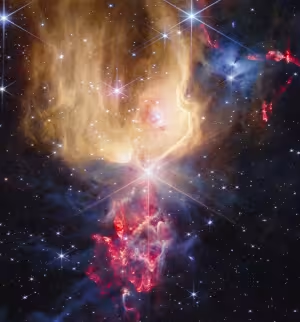
The golden blob near the top and the red blob near the bottom are caused by jets of material from the bright pre-main-sequence star in the middle (pre-main-sequence stars are still contracting under gravity and have not yet ignited nuclear fusion in their cores).
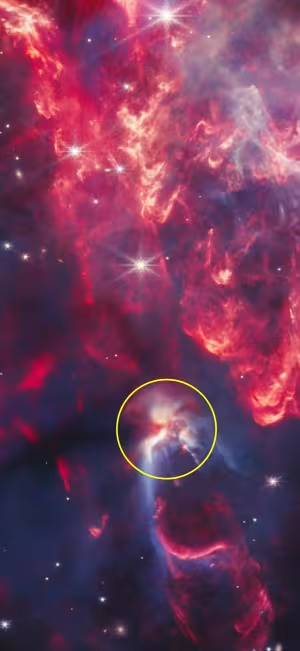
As stars accumulate matter during their formation process, some of that matter, through complications involving rotation and magnetic fields, gets ejected from their north and south poles.
You can see a smaller example of this in the cropped view below.
You can also see other pre-main-sequence stars in the golden blob, surrounded by bow shocks created by their stellar winds running up against the surrounding nebulosity.
And there’s also a shadow cast on the blue reflection nebula to the upper right, created by a protoplanetary disk of leftover material surrounding the equator of a protostar. This material will likely form new planets, moons, etc., over the next few million years.
In human spaceflight news, Crew-12 returned to Earth in their SpaceX Dragon this past week after living aboard the International Space Station for more than 200 days.
Their replacement, Crew-13, arrived at the ISS in a SpaceX Dragon the week before.
Related Content


